
What is a Custom Stock Screener?
A custom stock screener is a filtering tool. It allows you to define a set of criteria and then scan the market for companies that match those conditions.
At its simplest, a screener might look for companies with a price-to-earnings ratio below a certain threshold. More advanced approaches, such as our stock ratings methodology, combine multiple dimensions such as revenue growth, profitability, financial strength, and momentum. Instead of manually reviewing hundreds or thousands of stocks, the screener does the heavy lifting and returns a focused list of candidates worth your attention.
The key idea is not just convenience. It is consistency. A screener applies the same logic every time, without being influenced by headlines, recent price action, or emotion.
Best Stock Screener Parameters
There’s no “best” or one-size-fits-all approach. The filters you choose for your custom screener should reflect what you’re looking for. Below are a couple of examples of filters drawn from public screeners available in Finbotica.
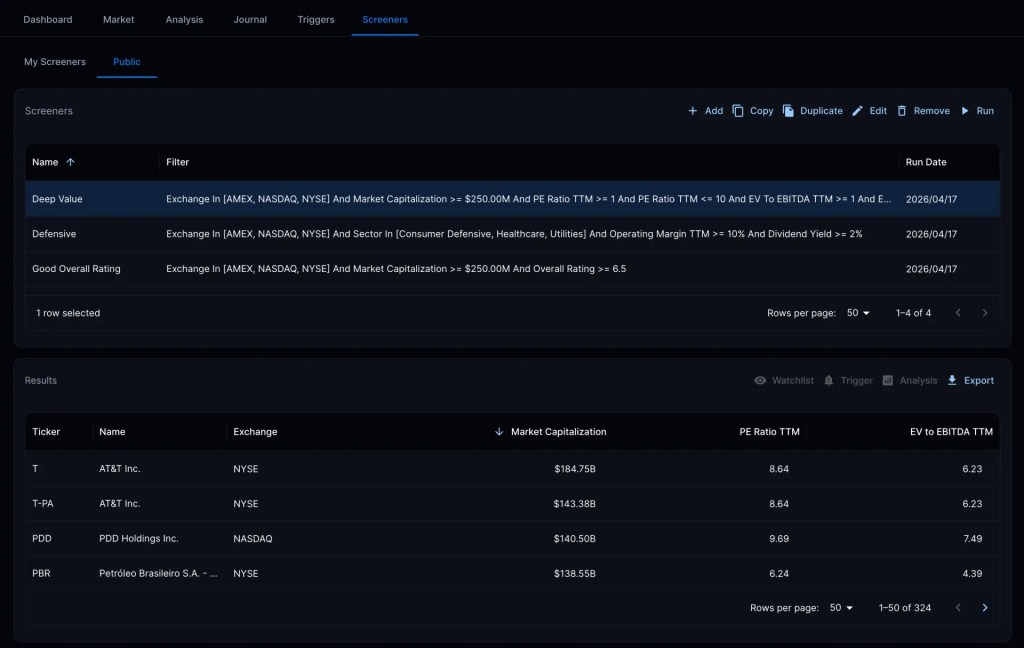
Deep Value Screener
Filter: Exchange In [AMEX, NASDAQ, NYSE] And Market Capitalization >= $250.00M And PE Ratio TTM >= 1 And PE Ratio TTM <= 10 And EV To EBITDA TTM >= 1 And EV To EBITDA TTM <= 8
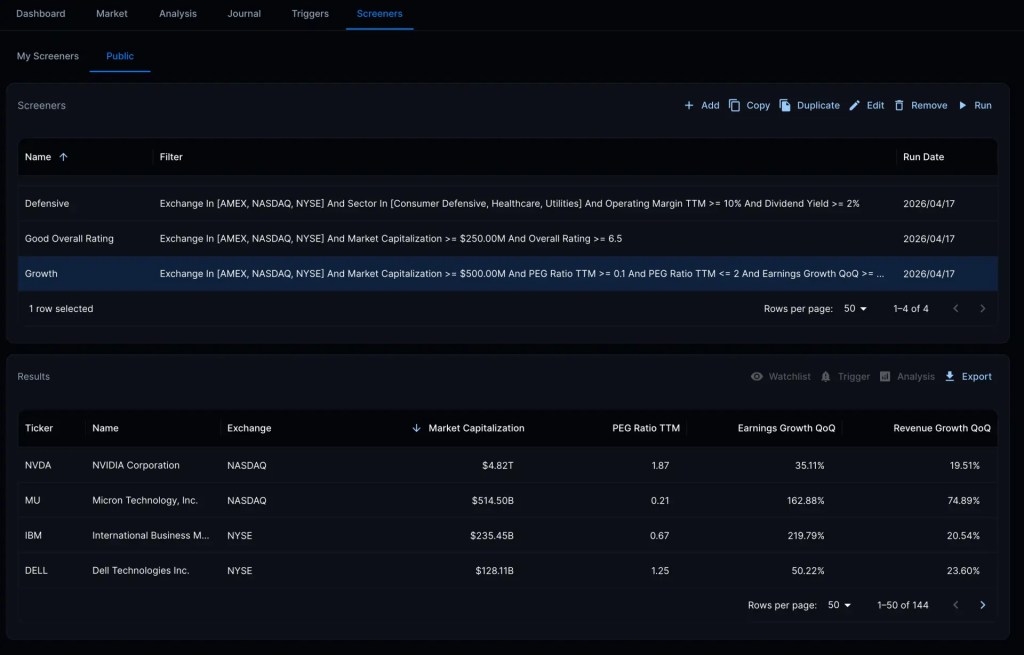
Growth Screener
Filter: Exchange In [AMEX, NASDAQ, NYSE] And Market Capitalization >= $500.00M And PEG Ratio TTM >= 0.1 And PEG Ratio TTM <= 2 And Earnings Growth QoQ >= 20% And Revenue Growth QoQ >= 15%
Why is a Custom Screener Important?
Most investors underestimate how much time they lose searching for ideas. They browse articles, scroll through social media, and jump between tools, often without a clear direction. Hours can pass without arriving at a single well-formed investment candidate.
A custom screening tool changes that dynamic in investment analysis. It compresses the discovery process into a structured, repeatable process. Instead of asking “What should I look at today?”, you define what you’re looking for once, and let the system surface opportunities that fit.
This has a second, more subtle benefit. It enforces discipline. When you rely on a defined set of criteria, you are less likely to chase whatever is trending or react to short-term market noise. You begin to operate from a framework rather than impulse.
Over time, this compounds. You spend less energy searching for potential opportunities and more time analyzing stocks. Your decisions become easier to compare because they originate from the same process. The result is not just efficiency, but clarity.
Common Stock Screening Mistakes to Avoid
Like any tool, a screener is only as effective as the way it is used. One of the most common mistakes is overfitting. Investors sometimes stack too many filters in an attempt to find the “perfect” stock. The result is often a list of one or two companies, or none at all. This creates a false sense of precision while actually limiting opportunity.
Another issue is relying on a single metric. A low valuation multiple might look attractive, but without context around growth, earnings quality, or financial stability, it can be misleading. Screeners work best when they balance multiple dimensions rather than optimizing for one.
There is also a tendency to treat screening as a one-time event. An investor runs a screener, finds a few names, and then moves on. Markets evolve, companies change, and new opportunities emerge. A custom screener should be part of an ongoing process, not a static snapshot.
Finally, it’s easy to forget what a screener is meant to do. It is not a decision engine. It is a starting point. The output of a screener is a list of candidates, not conclusions. The real work of deep stock analysis begins after the list is generated.
How to Build Your Own Screener
The best stock screeners start with intent. Before selecting any filters, decide what kind of opportunities you are looking for. Are you focused on growth, looking for companies with expanding revenues and earnings? Are you drawn to value, seeking mispriced businesses trading below their intrinsic worth? Or are you narrowing your focus to a specific sector where you believe there is an edge?
This initial decision shapes everything that follows.
Once you have a direction, the next step is to translate that idea into measurable criteria. A growth-oriented screener might emphasize revenue expansion and earnings trends. A value-focused approach might prioritize valuation ratios alongside financial strength. The goal is to align your filters with the underlying thesis, rather than selecting metrics at random.
From there, you define realistic yet selective ranges. If your criteria are too broad, you will end up with hundreds of results and lose focus. If they are too narrow, you risk missing viable opportunities. There is an element of iteration here. You adjust, review the output, and refine until the results feel manageable and relevant.
At this stage, it is helpful to review the companies that appear in your results. Do they match your expectations? Are they consistent with the strategy you set out to implement? If not, the issue is usually not the market. It is the filters.
What you are building is not just a query, but a repeatable system for idea generation. Over time, this becomes one of the most valuable assets in your investing process. It reflects how you think about the market and how you define opportunity.
Automating Your Screeners
Manual screening can still be time-consuming, especially if you frequently revisit your criteria. This is where automation changes the experience entirely.
In Finbotica, a custom screener doesn’t have to be a one-time search. Once created, it can run automatically in the background, evaluating your criteria against the market and updating the results without requiring any manual input.
This becomes even more powerful when combined with triggers. After setting up a screener, you can create a trigger that alerts you when something changes. A company entering your screener results might represent a new opportunity. A company leaving it could signal a shift in fundamentals or momentum worth reviewing.
Instead of repeatedly checking your screener, the system comes to you. You are alerted only when something meaningful happens. This shifts your role from constant monitoring to focused decision-making.
The effect is subtle but significant. You reduce the cognitive load of keeping up with the market. You avoid the habit of checking tools out of curiosity rather than purpose. Most importantly, you maintain alignment with your original strategy.
Automation does not replace thinking. It protects it. Handling the repetitive parts of the process gives you more space to analyze, reflect, and act with intention.
Bringing It All Together
A custom stock screener is often one of the first tools investors learn to use, but it is rarely used to its full potential. When approached casually, it becomes just another way to browse the market. When approached deliberately, it becomes a foundation for disciplined investing.
The difference lies in how it is integrated into your process. A well-designed screener reflects a clear strategy. It narrows the field of possibilities without losing flexibility. It evolves over time as your understanding deepens.
Paired with automation, it becomes something more powerful. It turns the market into a filtered stream of relevant opportunities rather than an overwhelming flow of information.
In a world where attention is constantly pulled in different directions, that shift matters. It allows you to spend less time searching and more time thinking. And in investing, that is often where the real edge is found